Plan tariff cost recovery before you change a single price.
LiveWhen duty rises on part of a catalog, the decision is not whether the cost exists but where it lands: absorbed into margin, spread across a category, or recovered on the specific SKUs that carry it. SkuWatch models recovery options as drafts for review. It does not add, calculate at checkout, or collect any fee.
Available on Shopify: this workflow is part of SkuWatch Tariff Recovery. The current app produces estimates, review states, recovery drafts, and finance CSVs; it does not change products, prices, orders, or checkout charges.
- Search intent
- Shopify merchants deciding how to recover rising tariff cost across affected SKUs without guessing at a blanket price rise.
- Workflow input
- Estimated landed cost per affected SKU, current pricing and margin, and the recovery approach the merchant chooses to model.
- Workflow output
- A read-only recovery plan per SKU showing the modeled change and the resulting margin. Nothing is applied to a store, and no fee is charged.
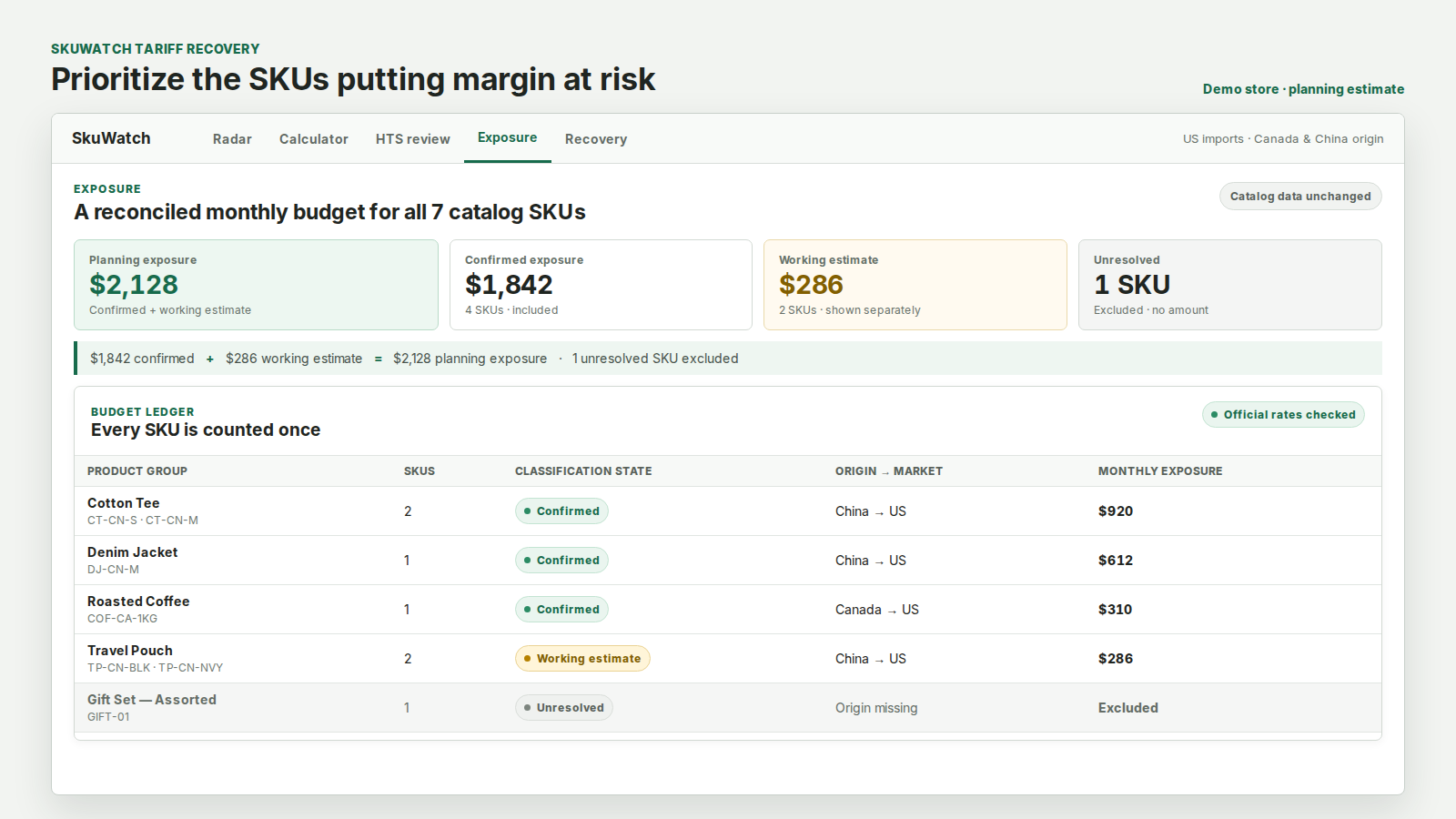
Read-only, merchant-approved planning; no automated fee
Blanket price rises are the usual response to a tariff change, and they are usually wrong in both directions: too much on products the measure never touched, too little on the ones carrying it. Recovery planning starts from the SKUs whose estimated landed cost actually moved and treats the decision as a question with several defensible answers rather than one automatic action.
Two boundaries define this capability, and both are deliberate:
- It is read-only. The output is a modeled plan. It does not write prices, does not create a checkout line item, does not calculate a fee at checkout, and does not collect money.
- It is merchant-approved. Nothing proceeds without an explicit decision by the merchant. A plan that is never approved simply has no effect.
Beyond that, the plan is only as sound as the cost estimate under it, which is why the order matters: confirm the classification, estimate the landed cost, then model the recovery. A recovery plan built on an unconfirmed HTS code inherits that uncertainty, and SkuWatch does not guarantee HTS accuracy.
This is planning support, not pricing, tax, legal, or customs advice. Whether a surcharge is appropriate, how it must be disclosed, and how it interacts with tax and consumer-protection rules in your markets are decisions for you and your advisers.
You can also establish the underlying number without connecting a store on the public calculator and follow how it is built up in the landed-cost guide.
How recovery planning works
Catalog facts, official tariff evidence, and estimates stay separated so unresolved inputs are visible before a decision.
Start from the affected SKUs
Take only the SKUs where an estimated landed cost actually moved, so recovery is targeted rather than applied across a whole catalog by reflex.
Compare recovery options read-only
Model absorbing the cost, spreading it, or recovering it on the affected SKUs, and show the resulting margin for each. Nothing is written to the store.
Leave the decision with the merchant
The plan is a proposal. A merchant reviews it, approves or discards it, and any price change remains theirs to make deliberately.
Live app, source-linked tariff data
The landed-cost logic behind a recovery draft uses the current published tariff snapshot. The app keeps its output review-only and does not change Shopify products, prices, orders, or checkout charges.
2026 HTS Rev 19 · synced · Operational
Inspect data and calculator status →Frequently asked questions
Does this add a tariff surcharge to my Shopify checkout?
No. Recovery planning is review-only. It does not add a fee, calculate a charge at checkout, or collect anything from a customer or merchant.
Is recovery planning available now?
Tariff Recovery is available on the Shopify App Store. It prepares recovery drafts and finance CSVs for manual review and setup; the current version does not change store prices or checkout charges.
What does merchant-approved mean here?
It means the output is a proposal that does nothing on its own. A merchant reviews the modeled options and decides. SkuWatch does not change prices, and it does not give pricing, tax, or customs advice.
Reference information only, not customs, legal, tax, or classification advice. SkuWatch does not guarantee HTS accuracy or a final duty amount; confirm material classifications and entry facts before acting.