See the margin the duty took, and the price that gets it back.
LiveA duty rate is not a decision. The decision is what it did to the margin on a specific product, and what price would hold that margin if you chose to move it. Those two numbers — margin after duty, and the break-even price — are what turn a tariff headline into something a merchant can act on before the next purchase order.
Available on Shopify: this workflow is part of SkuWatch Tariff Recovery. The current app produces estimates, review states, recovery drafts, and finance CSVs; it does not change products, prices, orders, or checkout charges.
- Search intent
- Merchants and buyers calculating margin impact and break-even pricing after a duty change, per product rather than per shipment.
- Workflow input
- Unit cost, current shelf price, HTS code, country of origin and entry date.
- Workflow output
- Margin before and after the duty stack, the points lost, and the break-even price that restores the pre-tariff unit margin.
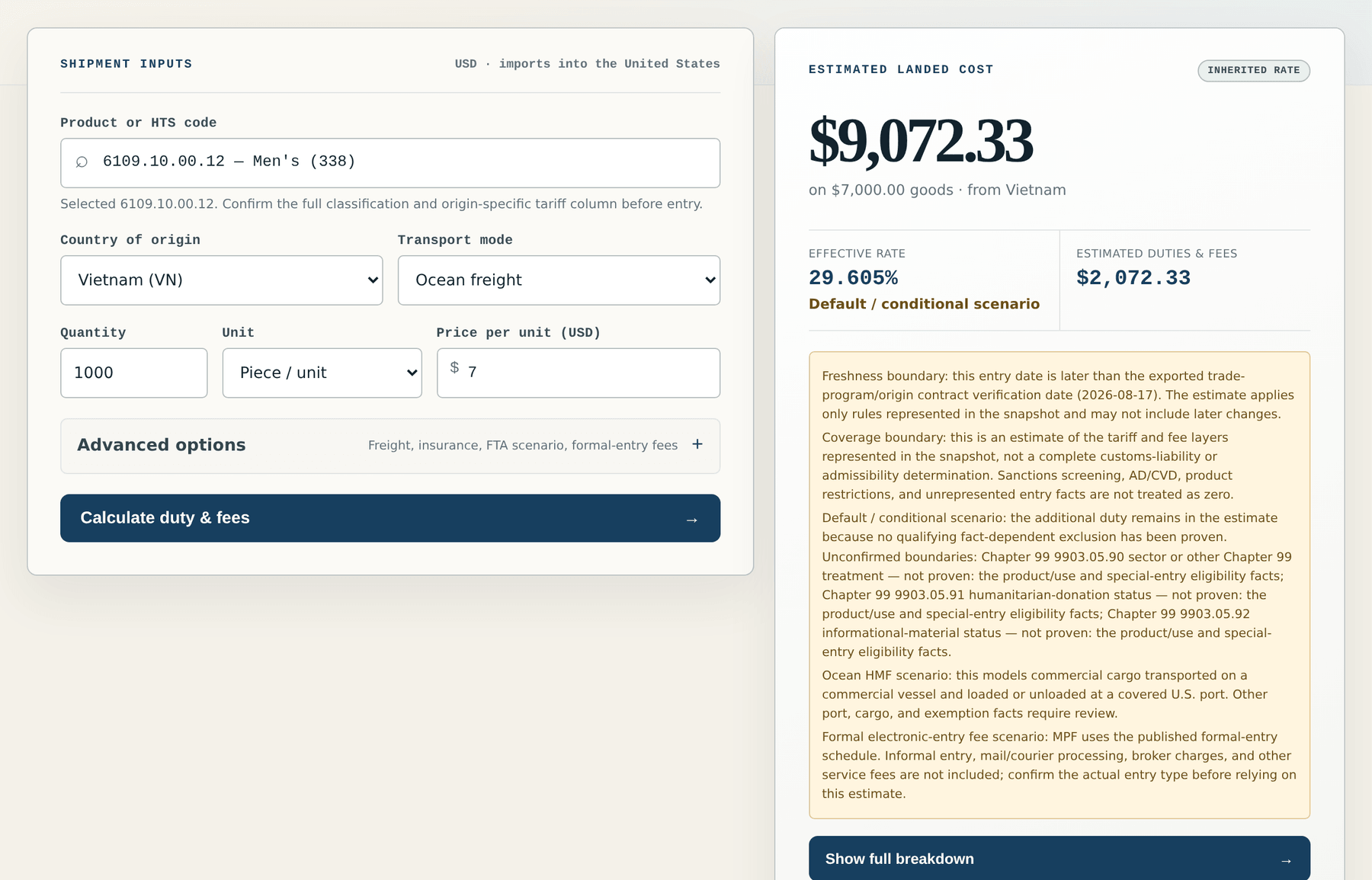
Margin after duty, points lost, and break-even
Most tariff coverage stops at the rate. A merchant needs three numbers past it: what the duty stack actually costs on this product, what the margin looks like afterwards, and what price would restore it.
The third one is the useful one. A break-even price makes the decision concrete — you can look at it and know immediately whether the market will bear it, whether the product should be re-sourced, or whether it should be dropped. A rate on its own tells you none of that.
Why per SKU
Margin impact depends on the ratio between the duty and the unit economics, so the same rate hits a thin-margin product and a rich one completely differently. Averaging across a catalog hides exactly the products that need the decision.
SkuWatch estimates from published official data and shows its working. It does not act as a customs broker, does not file or remit duty, and does not guarantee a classification, a duty amount, or a recovered margin.
The three figures worth having
Catalog facts, official tariff evidence, and estimates stay separated so unresolved inputs are visible before a decision.
Build the duty, layer by layer
Base rate, the trade actions in force on the entry date, and CBP fees. Each layer is shown separately with the official source behind it, so the total is auditable rather than asserted.
State the margin in points, not vibes
Margin before the duty, margin after it, and the points lost between them. Points lost is the number that decides whether a product is still worth stocking.
Name the price that restores it
The shelf price that holds the pre-tariff unit margin at the current duty rate. It is a reference point for a pricing decision, not an instruction.
Live app, source-linked tariff data
The duty stack behind each margin estimate is resolved against the current published schedule with every represented layer sourced. Tariff Recovery applies the same discipline to catalog exposure.
2026 HTS Rev 19 · synced · Operational
Inspect data and calculator status →Frequently asked questions
What does break-even price mean here?
The shelf price that would restore the unit margin the product had before the duty applied, at the current rate. It is a calculation, not a recommendation, and it does not account for demand at the higher price.
Does this include freight and insurance?
Duty is charged on the customs value. Freight and insurance join landed cost afterwards, and the calculator shows them separately so the dutiable base is never overstated.
Is the margin figure a guarantee?
No. It is an estimate built from the facts you supply and the published schedule. Classification, valuation, trade-program eligibility and entry type all change the outcome, and SkuWatch does not guarantee a duty amount or a recovered margin.
Can it do this for a whole catalog at once?
Yes. SkuWatch Tariff Recovery estimates catalog exposure and margin impact. The public calculator also runs one scenario at a time without a Shopify connection.
Reference information only, not customs, legal, tax, or classification advice. SkuWatch does not guarantee HTS accuracy or a final duty amount; confirm material classifications and entry facts before acting.